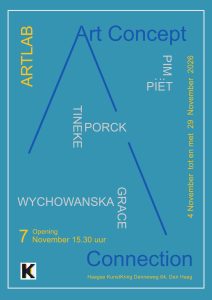
ARTLAB
Art Concept / Connection, the exhibition at the Haagse Kunstkring as part of the ARTLAB project, highlights the connection between the artistic concept and the development of the idea. This process unfolds in various phases throughout an artist’s career. As part of this ARTLAB project, the artists in this exhibition reveal connections between their earlier and later works, as well as the interconnections among the various works themselves.
The work of Pim Piët, Grace Wychowanska, and Tineke Porck belongs to the conceptual, concrete, and constructivist movements in art. The exhibition confirms that the different perspectives of the artists reveal common ground among the various artworks.
Grace Wychowanska’s body of work includes collages, drawings, paintings, and photography. In her work, she employs a distinctly geometric approach, in which architecture and the concept of the fourth dimension play a central role. Personal memories of specific events and situations serve as an important guiding principle. “I work spontaneously, often without sketches or computer programs, directly on the canvas; I create my paintings step by step.”
Wychowanska studied at the Willem de Kooning Academy in Rotterdam in the 1980s. In her early childhood, in her native Poland, she was introduced to abstract art in the studio of Henryk Stazewski (1894–1988), a pioneer of the avant-garde and one of the most important representatives of Constructivism in Poland. She is the initiator of the Art, Concept, Connection project and invited the other two artists to participate.
“Pim Piët’s work stems from a deep interest in language and its role in the process of perception. Words and letters serve a dual function in his work: they function both as carriers of meaning and as autonomous visual elements, blending communication and artistic form. Language is an integral part of the creative process; Piët’s paintings and installations can be read as visual poetry, in which each concept serves as the starting point for subsequent phases of a thematic cycle. The artist consistently develops series characterized by structural clarity, meticulous execution, and a carefully balanced layering that lends the works a contemplative character….. ‘
(Anna Klos, art historian)
“Tineke Porck stands by what she believes in. Art is meant to be misunderstood. In the case of Tineke Porck’s work, that’s quite difficult because her work actually explains itself. What’s there not to understand? All or nothing. That is the hallmark of every work by Porck: creating it is always a matter of all or nothing. The terms “deduction” and “reduction” apply here. When Porck visually analyzes a problem, she strips it down to its essence. She examines what she can do without and what she’s left with—usually two poles, a plus and a minus sign, a sum with no result, but with a solution. Her work resolves something. In it, something is balanced out. Her work is a peculiar unity of opposites, captured in light, space, form, and character. Each work, as an object, possesses a personality in which reason and emotion are intertwined.’
(Alex de Vries, author)